The Soft Pause: Science-Backed Ways to Gently Ease Your Body Into Rest
Many people think relaxation is something that should just “happen” when the day is over. Yet for most of us, the nervous system doesn’t work like a light switch. It’s more like a dimmer—gradually shifting from alertness to ease. This article is about that soft, gradual shift: how to help your body and mind step out of “go mode” and into a calmer, sleep-ready state using evidence-backed techniques, thoughtful tools, and a kinder inner pace.
Understanding Your Body’s Quiet Mode
Your ability to relax is rooted in your nervous system. During the day, you spend a lot of time in “sympathetic” mode—your body’s built-in system for focus, movement, and dealing with stress. For rest and sleep, you need the opposite: the “parasympathetic” system, often called the “rest and digest” state. Relaxation is the gentle bridge between these two.
Research shows that practices which slow breathing, soften light exposure, and lower internal “threat signals” can help your heart rate, blood pressure, and stress hormones move toward a calmer baseline. This doesn’t always feel dramatic; often it’s subtle—slightly looser shoulders, a quieter jaw, a slower stream of thoughts. Over time, these small shifts add up, signaling to the brain that it’s safe to power down.
The key idea: relaxation is not laziness or avoidance. It is a biological process, supported by concrete behaviors—especially in the 1–2 hours before bed. You are not “bad at relaxing”; your body just may need a clearer, more consistent path into its quiet mode.
Breathing That Nudges the Brain Toward Calm
Breath is one of the few levers you can control directly that has an immediate effect on your nervous system. Slow, gentle breathing can activate the vagus nerve, which supports the rest-and-digest response and helps your heart rate become more steady.
A simple approach is “extended exhale breathing”:
- Sit or lie comfortably, shoulders soft.
- Inhale quietly through your nose for about 4 seconds.
- Exhale through your nose or mouth for about 6–8 seconds, as if gently fogging a window.
- Repeat for 3–5 minutes.
Extending the exhale has been linked with reduced heart rate and increased heart rate variability—both markers of a calmer physiological state. The rhythm matters less than consistency; what helps most is breathing in a way that feels sustainable and not strained.
If counting triggers anxiety, use anchors instead: breathe in for the length of a short phrase like “I am breathing in,” and out for a longer phrase like “My body can soften now.” Let the breath be warm and unforced. Over time, your body starts to recognize this pattern as a cue for winding down.
Light, Screens, and the Quieting of the Brain
Relaxation is not only about what you feel; it’s also about what your brain is seeing. Light—especially blue-enriched light from screens—signals daytime to your internal clock. In the evening, that signal can delay melatonin release, make you feel more alert, and push sleepiness later into the night.
Two angles matter here: brightness and distance.
- Brightness: Dim overhead lights 60–90 minutes before bed. Switch to softer lamps or warm-toned bulbs. Even this small adjustment can help your body strengthen its natural evening signal.
- Distance: The closer a bright screen is to your eyes, the stronger the alerting effect. If you must use a device, keep it farther from your face, enable night mode, and reduce overall brightness.
This doesn’t have to be perfect. Think of it as moving from “daylight intensity” to “campfire intensity.” This gentler visual environment helps the brain slow its pace and makes relaxation techniques more effective because your biology is getting consistent messages: it is time to begin letting go.
Evidence-Backed Tools That Can Support Relaxation
Products can’t “fix” sleep on their own, but certain tools can support the conditions that make relaxation easier. The most helpful ones generally do one of three things: reduce sensory overload, enhance comfort, or support temperature regulation. Here are a few categories with research-informed notes:
Weighted blankets (for some people)
Weighted blankets apply gentle, even pressure across the body. Early studies suggest they may reduce perceived anxiety and restlessness in some individuals, possibly by stimulating pressure receptors linked to calming pathways. If you try one, choose a weight around 8–12% of your body weight, and avoid them if you have breathing, circulation, or mobility issues without consulting a clinician.
Eye masks and blackout curtains
Darkness is a quieting signal. Eye masks and blackout curtains reduce stray light that can nudge your brain toward wakefulness—especially if you live in a city or have early sunrise. Even a basic soft eye mask can deepen the sense of “being off duty” by creating a small cocoon of darkness for your eyes.
White noise or gentle sound machines
For light sleepers or those who live with unpredictable noise, a consistent low-level sound—like a white noise machine or a fan—can mask sudden auditory spikes that might otherwise trigger mini-surges of alertness. Studies show white noise can improve sleep continuity in noisy environments, which in turn supports deeper rest over the night.
Cooling bedding and mattress toppers
Your core body temperature naturally drops in the evening. Overly warm sleep environments can interfere with this process. Breathable sheets, cooling mattress toppers, or moisture-wicking sleepwear can help your body release heat more easily, making it simpler to slip into a relaxed, drowsy state.
Think of these tools as gentle scaffolding for the real work your body is doing: shifting from protection to restoration.
Simple Body-Based Practices to Unwind Tension
The mind can be stubborn, but the body often responds quickly to physical cues. Gentle movement and muscle-focused relaxation techniques can help release accumulated tension from the day, sending a clear message to your nervous system that it can soften its grip.
Progressive muscle relaxation (PMR)
PMR is a structured way of tensing and then relaxing muscle groups, which has been shown to reduce anxiety and improve sleep for some people.
You can try a brief version in bed:
- Start with your feet: gently curl your toes, hold 5 seconds, then release.
- Move to calves, thighs, stomach, hands, arms, shoulders, face—one region at a time.
- Each time, notice the contrast between tension and release.
- Move slowly, do not strain, and let the exhale accompany the letting go.
This process increases body awareness and helps you notice areas that stay clenched—jaw, shoulders, hands—giving you a chance to intentionally relax them.
Gentle stretching or “floor time”
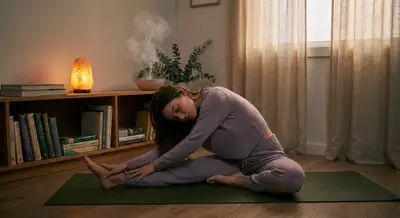
Spending 5–10 minutes on the floor with slow stretches—like lying on your back with knees bent, rolling your shoulders, or lightly stretching your hips—can slow you down physically and mentally. Keep movements simple, pain-free, and unhurried. The goal is not workout performance; it’s comfort and signals of safety.
Calming the Thought Stream Without Forcing “Blankness”
Many people feel most mentally busy right when they try to relax. This is not a failure; it is often the first moment of the day your brain is not occupied, so unsorted thoughts rush in. Instead of trying to empty your mind, it can help to gently organize or redirect it.
The “parking lot” page
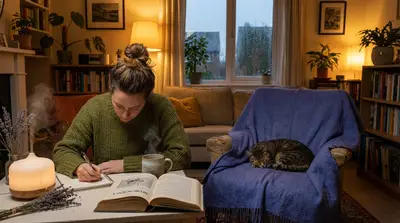
Keep a notebook or notes app near your bed. If thoughts about tasks, worries, or ideas keep looping, briefly write them down—like placing them in a mental parking lot for tomorrow. Research suggests that this simple act of externalizing future tasks can reduce pre-sleep worry and help people fall asleep faster.
Soft-focus attention
Rather than forcing yourself to think of “nothing,” choose a neutral anchor. This could be:
- Noticing the feeling of the sheets on your skin
- Watching the gentle rise and fall of your abdomen
- Imagining a slow, repetitive scene (waves, trees swaying, a quiet forest path)
When your mind wanders—as it will—kindly guide it back, like escorting a child back to their seat without irritation. This is a form of informal mindfulness, which has been associated with better sleep quality and reduced insomnia symptoms.
A Gentle Evening Flow You Can Adjust to Your Life
Everyone’s evening looks different, but it can help to think in terms of a soft sequence rather than a rigid routine. Here is a flexible, research-aligned framework you can adapt:
Transition (60–90 minutes before bed)
- Dim lights, reduce loud or fast-paced content.
- Finish stimulating tasks—work emails, intense discussions, high-adrenaline shows.
Release (30–45 minutes before bed)
- Do 5–10 minutes of gentle stretching or a warm shower.
- Try 3–5 minutes of extended exhale breathing or progressive muscle relaxation.
Quieting (15–30 minutes before bed)
- Use softer activities: light reading, an audiobook, soothing music, or journaling.
- If using screens, keep brightness low and devices at a distance.
Nest (in bed)
- Set your sleep environment: comfortable temperature, preferred pillow, eye mask or white noise if helpful.
- Choose one calming focus: breath, a body scan, or a simple visualization.
The aim is not perfection, but predictability. When your evenings follow a broadly similar shape, your brain begins to recognize the pattern as a cue that rest is coming—and it can start downshifting sooner.
Conclusion
Relaxation is not a luxury; it is a biological bridge your body needs to cross from survival mode into repair mode. When you understand how your nervous system, breathing, light exposure, and physical tension interact, the process becomes less mysterious and more workable.
You do not need an elaborate ritual or a long list of specialized products to rest better. A few calm breaths with longer exhales, dimmer light, a more comfortable sleep space, and a kinder relationship with your thoughts can, over time, reshape how your body approaches the night. Think of each evening as an invitation, not a test: a chance to offer your nervous system a softer landing so sleep can arrive more naturally.
Sources
- National Institutes of Health – Relaxation techniques: Breath control helps quell errant stress response – Overview of breathing and relaxation methods and their effects on stress and the nervous system.
- Harvard Medical School – Blue light has a dark side – Explains how evening light and screens affect melatonin, alertness, and sleep.
- Cleveland Clinic – Progressive Muscle Relaxation – Practical guide and clinical perspective on progressive muscle relaxation for stress and sleep.
- Mayo Clinic – Weighted blankets: Can they help with anxiety and sleep? – Evidence-based discussion of benefits, risks, and appropriate use of weighted blankets.
- Journal of Experimental Psychology – “Writing about worries eases anxiety and improves test performance” (via APA) – Research summary on how writing down concerns (similar to a “parking lot” page) reduces worry and improves performance and calm.